Spin Cycle, Small Talk: What the Local Launderette Knows About Us
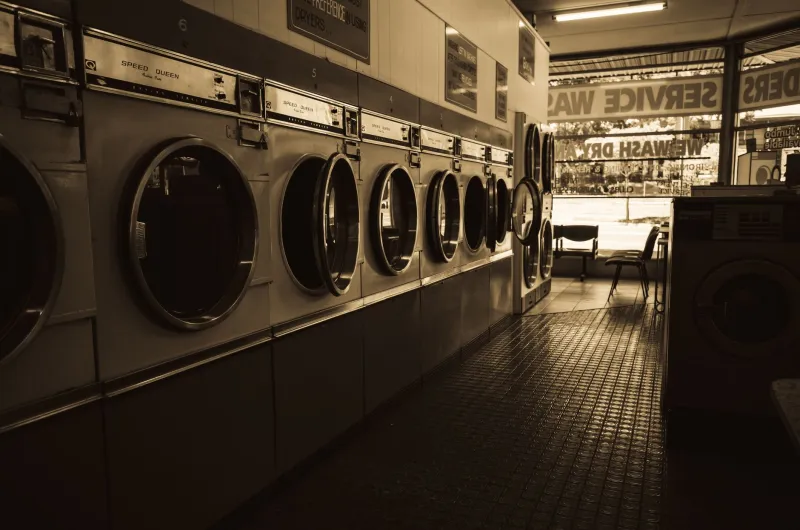
There is a particular sound to a launderette on a wet Tuesday morning. Not the dramatic whoosh of a washing machine at home, but a low, mechanical hum, punctuated by the clatter of coins, the squeak of a trolley wheel and the occasional thump of a dryer that has decided to make its presence felt. You walk in with a bin bag of damp towels and a vague sense that you are interrupting something. Then someone nods, shifts a laundry basket an inch to the left, and the room quietly makes space for you.
That nod is the beginning of the launderette’s strange social contract. It is not a club. There is no membership card, no committee, no WhatsApp group. But for an hour or so, a group of people who would otherwise never speak are briefly bound together by the same task: waiting for clothes to stop being wet.
The accidental waiting room
Most of us do not go to the launderette for company. We go because the washing machine in the flat has been broken since August, or because the rented house has a washer but no dryer, or because the service wash down the road costs more than a week’s worth of bus fares. Some go because they are students in a hall with a laundry app that never works. Some go because they are between homes. Some go because they have lived in the same street for thirty years and the launderette is simply where the big items go.
The reasons are practical. The result is social, almost by accident.
Unlike a café, you do not have to buy anything to stay. Unlike a library, you do not have to be quiet. Unlike a pub, you do not have to pretend you are having a better time than you are. The launderette asks only that you do not hog the dryer and that you remember which machine is yours. It is a low-stakes room with a high-stakes tumble dryer.
And because everyone is stuck there for roughly the same amount of time, the usual barriers soften. You cannot leave. You have nothing to do. So you look up.
The rules of the spin cycle
The etiquette is unwritten but remarkably consistent. First, there is the machine dance: the slow circuit of the room, peering at dials, checking for the green light, trying to work out whether the person before you has actually finished or merely gone for a cigarette. Then there is the bench. The bench is where the waiting happens, and where the real theatre takes place.
Some people read. Some people scroll. Some people stare at the drum as if it might reveal a secret. The talkers are in the minority, but they set the temperature. A woman will ask whether the middle dryer is any good. A man will offer a detergent pod because he has one spare. Someone will complain about the price of a wash and everyone will nod, because what else is there to say? It is expensive, it is slow, and yet here we are.
The dryer guard is a recognised role. This is the person who has finished their wash but cannot leave because their bedding is still damp, so they sit sentinel beside the machine, one eye on the timer and one eye on the door. They will tell you when your cycle is done. They will not make a fuss about it. They will simply say, “That’s you, love,” and return to their phone. It is a small act of civic duty, performed without ceremony.
Then there is the unspoken rule about conversation. You do not launch into anything too personal. You talk about weather, machines, the price of electricity, the state of the high street. You talk sideways, not face to face, often while folding a sheet. The folding gives your hands something to do and your eyes somewhere to look. It is easier to be honest when you are not quite looking at each other.
A seat at the bench
What strikes me most about the launderette is how mixed it is. In one row you might find a retired couple with a duvet, a delivery driver washing their uniform before a night shift, a student with a fortnight’s worth of laundry and an older man who has been coming to the same place since his wife died. They do not necessarily become friends. But they become familiar. They recognise each other’s baskets. They know who takes the big machine on a Friday.
That familiarity is not the same as friendship, and it does not need to be. It is something quieter: the sense that you are part of a place, even temporarily. In a city where so much of life is ringfenced by cost — the coffee you buy to sit down, the gym membership you pay for to feel less lonely, the app that promises community for a monthly fee — the launderette remains stubbornly ordinary. It is not trying to be anything. That is precisely why it works.
Why it matters now
We hear a lot about the decline of informal meeting places. The high street has been hollowed out, the pub is a luxury for many, and the local library is often the only free indoor space left. The launderette sits in that same fragile category. It is a business, of course, and it has to pay its bills. But it also performs a function that no one designed: it gives people a reason to be in the same room without demanding that they perform sociability.
That matters. Loneliness is not always solved by big gestures or organised fun. Sometimes it is softened by a nod, a spare pod, a shared complaint about the dryer. The launderette hour is not a solution to modern life. But it is a reminder that belonging can be small, unglamorous and slightly damp around the edges.
So next time you are hauling a bin bag down the road, look around the bench. There is a whole quiet world in there, spinning away. It will not ask you to join. It will just shuffle up.